Glutathione in Canada: What the Research Actually Shows
- Last reviewed
- Nov 9, 2026: every PMID was opened and checked on this date.
- Reviewed by
- Peak Peptides Research Team
- Evidence labels
- Biochemistry reviewsAnimalHuman
- How we evaluated the evidence
- We opened every cited PMID on PubMed, read each abstract, and labelled each finding by the model that produced it. Reviews are cited for what their authors concluded, not as new data.
- Disclosure
- Peak Peptides sells research compounds discussed here.
In short
Glutathione (GSH) is a tripeptide of glutamate, cysteine and glycine, and the most abundant antioxidant the body makes. Oral glutathione's absorption has long been questioned, but a 6-month randomized trial found daily supplements raised body stores.[1] Peak Peptides supplies lyophilized glutathione research peptide material in Canada.
- What glutathione is
- Why the fitness and wellness community is interested
- Why researchers measure glutathione levels
- Oral glutathione: the human trials
- The precursor route: GlyNAC
- Skin-pigmentation research
- Glutathione vs NAD+ vs NAC
- Storage and the COA
- FAQ
- References
Key takeaways
- Glutathione is a tripeptide. Its full name is γ-L-glutamyl-L-cysteinyl-glycine, and it is a cofactor for antioxidant and detoxification enzymes.[2][3]
- Oral results are mixed. A 6-month randomized trial (n = 54) reported higher body stores; a 4-week randomized trial (n = 40) found glutathione status unchanged.[1][4]
- Skin evidence is inconclusive. Two systematic reviews report lower melanin index in some oral and topical trials; reviewers call the evidence inconclusive and the effects unsustainable.[5][6]
What is glutathione, and is it a peptide?
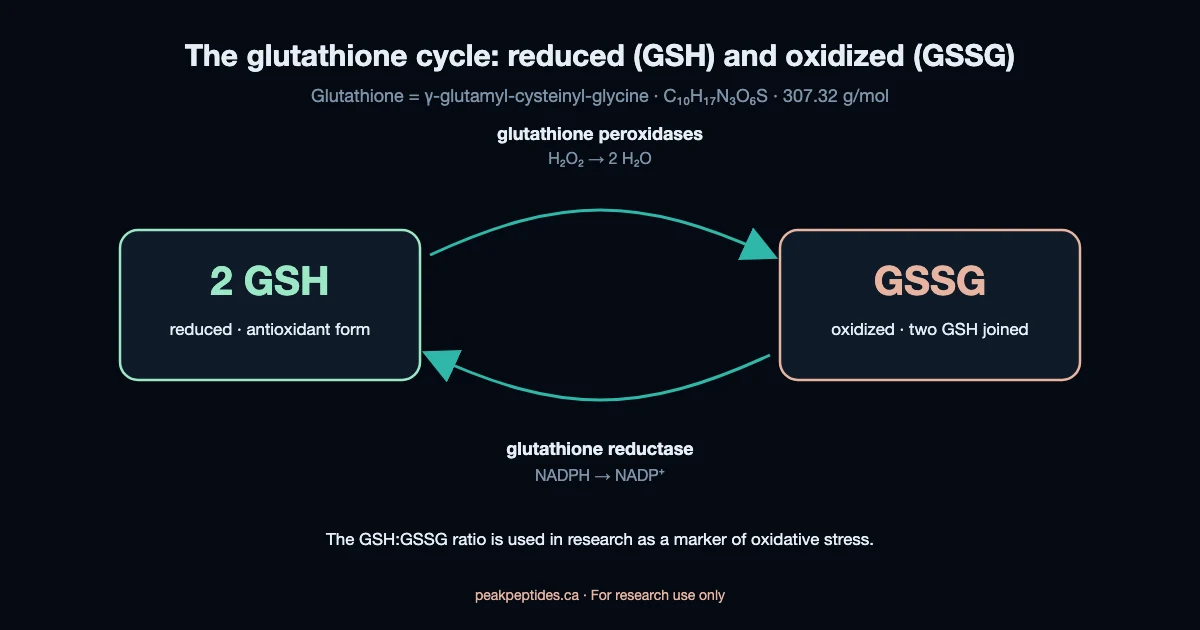
Glutathione is a three-amino-acid peptide and the central redox molecule of most aerobic organisms.[2] It exists in a reduced form (GSH) and an oxidized form (GSSG), and the balance between them is a standard marker of oxidative stress.[1][7]
Yes, glutathione is a peptide, though an unusual one: γ-L-glutamyl-L-cysteinyl-glycine. The "γ" (gamma) means glutamate joins cysteine through its side-chain carboxyl group, not the standard alpha peptide bond. Cells build it in two ATP-dependent steps, with glutamate cysteine ligase and cysteine supply as the rate-limiting factors.[2] Its CAS number is 70-18-8, formula C₁₀H₁₇N₃O₆S, molecular weight 307.32 g/mol.
Reduced (GSH) vs oxidized (GSSG) glutathione
Reduced glutathione (GSH) is the working form. When glutathione peroxidases detoxify peroxides, GSH is oxidized to glutathione disulfide (GSSG); glutathione reductase, with NADPH, converts it back.[3]
Because oxidative stress shifts that balance toward GSSG, researchers track the GSH:GSSG ratio. In a 2022 trial, healthy older adults (mean age 65) had higher GSSG and a lower reduced-to-oxidized ratio (11.78 vs 15.26) than a young reference group of 20.[7]
Why is the fitness and wellness community researching glutathione?
Glutathione is one of the most-discussed compounds in fitness and wellness circles, for four main reasons.
| Interest | Why people are interested | What the research shows | PMID |
|---|---|---|---|
| Skin brightening and even tone | The most-searched reason: glutathione is linked to lighter, more even skin | Two systematic reviews (human): oral glutathione at 250–500 mg/day lowered melanin index vs placebo in some randomized trials; topical oxidized glutathione was also studied. One review called the evidence inconclusive | 30895708, 39444151, 33871071[5][6][8] |
| Exercise recovery and fatigue | Antioxidant support for hard training; less fatigue | Mice, plus a double-blind crossover in 8 healthy men: 2 weeks of oral glutathione (1 g/day) suppressed the post-exercise rise in blood lactate and lowered fatigue-related scores | 25685110[9] |
| "Detox" and liver support | Glutathione is the cell's main detoxification cofactor | Mechanistic: glutathione S-transferases and peroxidases use GSH to neutralize oxidants and foreign compounds. The biochemistry is well described; none of the sources here tested a "detox" outcome in people | 36707132[3] |
| Healthy ageing and immunity | Levels fall with age; interest in immune function | A review describes an age-related decline in GSH; a liposomal glutathione pilot (human, n = 12) raised body stores and immune markers | 37683986, 28853742[2][10] |
Each row reports what the cited abstracts found, not an outcome to expect. Human trials here enrolled 8 to 46 participants.
Skin. The 2019 review judged the evidence inconclusive because of study quality and inconsistent findings; details are in the skin section below.[5]
Exercise. In the human arm, blood lactate after 60 minutes of cycling was 2.9 mM with glutathione vs 3.4 mM with placebo, in only eight participants.[9]
Detox. Glutathione S-transferases use GSH to process electrophilic substances and xenobiotics.[3] That is cell biology, not evidence that a supplement changes whole-body detoxification.
Ageing. Lapenna's review links the fall in GSH with age generally to impaired synthesis.[2] The liposomal study was a 1-month pilot with no placebo group described in its abstract.[10]
Why do researchers study glutathione levels?
Glutathione is central to redox balance and detoxification enzymes, and its levels change with age.
Averill-Bates describes GSH as an essential antioxidant in mammalian cells. It can regenerate vitamin E after lipid-radical reactions, and it regulates redox signalling through reversible modification of critical protein cysteines (S-glutathionylation). Three enzyme families use it as a cofactor: glutathione peroxidases (peroxides), glutathione S-transferases (electrophiles and xenobiotics) and glyoxalases (methylglyoxal stress).[3]
GSH levels decline during ageing, a change Lapenna's review links to cell dysfunction; the review also discusses NAC-glycine strategies aimed at raising them.[2]
Does oral glutathione work? What do the human trials show?
Four small human trials measured glutathione taken by mouth. The 6-month trial and the liposomal pilot reported higher body stores; the two shortest trials did not show a clear rise.
| Study | Year | Model | Finding | PMID |
|---|---|---|---|---|
| Allen and Bradley | 2011 | Human, double-blind placebo-controlled RCT, n = 40 healthy adults (39 completed); 500 mg twice daily for 4 weeks | No significant change in urinary oxidative-stress markers (F2-isoprostanes, 8-OHdG). Erythrocyte GSH, GSSG and their ratio unchanged | 21875351[4] |
| Richie et al. | 2015 | Human, double-blind placebo-controlled RCT, n = 54 non-smoking adults; 250 or 1,000 mg/day for 6 months | Blood GSH rose at 1, 3 and 6 months at both doses. At 6 months, high dose: up 30–35% in erythrocytes, plasma and lymphocytes and 260% in buccal cells. Low dose: up 17% in blood and 29% in erythrocytes. Levels returned to baseline after a 1-month washout | 24791752[1] |
| Sinha et al. | 2018 | Human, 1-month pilot, n = 12 healthy adults; liposomal GSH at 500 or 1,000 mg/day | GSH up from week 1, with maximum increases at 2 weeks: 40% in whole blood, 25% in erythrocytes, 28% in plasma, 100% in PBMCs. Plasma 8-isoprostane down 35%. No difference between doses (limited power) | 28853742[10] |
| Søndergård et al. | 2021 | Human, double-blind placebo-controlled RCT, n = 20 obese males (10 with type 2 diabetes); 1,000 mg/day for 3 weeks | Whole-body insulin sensitivity increased significantly in the GSH group. Muscle GSH numerically up about 19%; GSH:GSSG ratio and oxidative-stress markers unchanged | 33740389[11] |
RCT: randomized controlled trial. PBMCs: peripheral blood mononuclear cells. 8-OHdG: a DNA-oxidation marker. Percentages are as reported in each abstract.
Richie 2015: the longest trial
Both of Richie's dose groups had a lower oxidized-to-reduced glutathione ratio in whole blood at 6 months, and natural killer cell cytotoxicity more than doubled versus placebo at 3 months in the high-dose group.[1] The often-quoted 260% applies only to buccal (cheek) cells in the high-dose group.
What pattern do the four trials show?
The 6-month trial and the liposomal pilot reported rises in body stores.[1][10] The 3- and 4-week trials of standard oral glutathione found glutathione status unchanged (Allen) or only numerically higher in muscle (Søndergård, which did report higher insulin sensitivity).[4][11] Duration alone does not explain the split: Richie saw blood GSH rise by month 1, while Allen saw no erythrocyte change at week 4.
All four trials are small (12 to 54 participants), and the liposomal study was funded by a liposomal glutathione supplier, as its authors disclose.[10]
What about the precursor route: glycine plus NAC (GlyNAC)?
Because cysteine supply limits glutathione synthesis, and cysteine can be supplied as N-acetylcysteine (NAC), some studies provide its building blocks instead.[2] Lizzo and colleagues randomized 114 healthy older adults (mean age 65) to glycine plus NAC at 2.4, 4.8 or 7.2 g/day, or placebo, for 2 weeks. GlyNAC was safe and well tolerated but did not raise total glutathione or the GSH:GSSG ratio, the primary endpoint. In a post-hoc subgroup with high oxidative stress and low baseline glutathione, the medium and high doses were associated with higher total glutathione (905.4 vs 819.7 mg/L).[7] That subgroup was post-hoc, and most authors were Nestlé employees.
What does skin-pigmentation research on glutathione show?
Two systematic reviews and one randomized trial report lower melanin index in some studies, with clear caveats about quality, consistency and durability.
Melanin index is an instrument reading of skin pigment, taken with a mexameter in one trial below; a lower value is read as lighter skin.[8][5]
2019 systematic review: four studies
Dilokthornsakul and colleagues found four eligible studies in healthy volunteers (searches to October 2017): three placebo-controlled RCTs and one single-arm trial, one topical and three oral at 250 to 500 mg/day. Oral glutathione at 500 mg/day and topical 2.0% oxidized glutathione lowered melanin index on sun-exposed skin; no significant differences were seen on sun-protected skin. The authors concluded the evidence is "still inconclusive due to the quality of included studies and inconsistent findings."[5]
2025 systematic review: skin lightening and melasma
Sarkar and colleagues reviewed 10 years of literature. Five RCTs and one open-arm study of oral glutathione, at 250 mg once daily, 250 mg twice daily or 500 mg once daily, showed a significant reduction in melanin index compared with placebo, and topical 2% plus oral glutathione outperformed either alone. Risk-of-bias ratings were split roughly evenly between low and high. The authors rated both routes moderately efficacious, oral with substantial adverse effects versus minimal for topical, and both "unsustainable."[6]
On intravenous use the review found only one placebo-controlled study, and concluded IV glutathione is contraindicated due to lack of efficacy and side effects.[6]
2021 combination trial
Wahab and colleagues randomized 46 participants to oral glutathione or oral placebo; each also applied topical glutathione to one side of the face and placebo to the other. Over 8 weeks, the combination group had a significantly lower melanin index than placebo, and the authors suggested combination use "might be superior" to either alone.[8] The abstract is not fully consistent, though: it also reports the combination group's mean melanin index as the highest of all groups. It was one small, 8-week trial.
What these studies do not establish: long-term durability, effects on sun-protected skin, or any role for injected glutathione.[5][6] For other compounds in skin research, see our overview of peptides studied in skin ageing research and our GHK-Cu vs retinol comparison.
How do glutathione, NAD+ and NAC compare?
These three sit at different points in one system. Glutathione is the antioxidant and enzyme cofactor itself. NAC supplies cysteine, a rate-limiting building block for making glutathione.[2] NAD+ is a coenzyme in the cell's energy and redox reactions; a related molecule, NADPH, is the cofactor glutathione reductase uses to recycle GSSG back to GSH.[3]
| Compound | What it is | Role in redox and energy | Main evidence in this guide | At Peak Peptides |
|---|---|---|---|---|
| Glutathione (GSH) | Tripeptide, γ-L-glutamyl-L-cysteinyl-glycine | Direct antioxidant; cofactor for glutathione peroxidases and S-transferases[3][2] | Human: three RCTs of oral supplementation (n = 20 to 54), a liposomal pilot (n = 12), two skin systematic reviews | Glutathione 1500 mg |
| NAC (N-acetylcysteine) | Acetylated form of the amino acid cysteine | Supplies cysteine, a rate-limiting precursor for GSH synthesis[2] | Human: one RCT of glycine plus NAC in older adults (n = 114); primary endpoint not met[7] | Not linked in this guide |
| NAD+ (nicotinamide adenine dinucleotide) | Coenzyme | Coenzyme in cellular energy and redox reactions; the related NADPH lets glutathione reductase recycle GSSG to GSH[3] | Not reviewed in this guide | NAD+ 1000 mg |
"Main evidence" covers only the studies cited in this article.
How should lyophilized glutathione be stored, and what should its COA show?
Lyophilized (freeze-dried) glutathione is a dry powder. In the lab it is typically stored at −20 °C, kept dry and away from light, and left sealed until use.
Glutathione is a thiol, and its antioxidant work involves being oxidized to the disulfide GSSG.[2][3] Labs limit moisture, warmth, light and repeated opening to reduce that change. Our article on lyophilized peptide stability explains why that matters for shelf life.
What to check on a glutathione COA
- Purity percentage. Peak's glutathione is >98%.
- Batch or lot number that matches the number on the vial.
- Test date for that batch.
- Named independent laboratory that ran the test.
- Molecular weight that matches the product's specification: 307.32 g/mol for glutathione.
Third-party tested, >98% purity, COA published. In Canada, Peak Peptides supplies glutathione as a laboratory research material, not as a natural health product or drug.
Frequently asked questions about glutathione
Is glutathione a peptide?
Yes. Glutathione is a tripeptide of glutamate, cysteine and glycine, written γ-L-glutamyl-L-cysteinyl-glycine. It is unusual because glutamate links to cysteine through its side-chain (gamma) carboxyl group rather than the standard alpha peptide bond. Cells make it in two ATP-dependent steps, with cysteine supply as a rate-limiting factor.[2]
Is oral glutathione absorbed, or broken down in the gut?
The evidence is mixed. A 2019 review said oral efficacy was questionable because of limited absorption and bioavailability, and a 4-week randomized trial (n = 40) found glutathione status unchanged. A 6-month randomized trial in 54 adults, however, found blood glutathione rose at both 250 and 1,000 mg/day, and a liposomal pilot (n = 12) reported increases within a week. The trials were small.[5][4][1][10]
What is the difference between reduced and oxidized glutathione?
Reduced glutathione (GSH) is the active form. When glutathione peroxidases detoxify peroxides, GSH is oxidized to glutathione disulfide (GSSG), and glutathione reductase converts it back using NADPH. Because oxidative stress shifts the balance toward GSSG, researchers use the GSH:GSSG ratio as a marker; in one trial, healthy older adults had a lower ratio than a young reference group.[3][7]
How should lyophilized glutathione be stored?
In the lab, lyophilized glutathione is typically kept sealed at −20 °C, dry and away from light until use. Because GSH is a thiol that oxidizes to glutathione disulfide (GSSG), limiting moisture, warmth and air exposure is intended to reduce change before an experiment. Check the product page for the supplier's storage guidance.[3]
Where can researchers buy lab-tested glutathione in Canada?
Look for a supplier that publishes a batch-specific certificate of analysis: check the purity percentage, a batch or lot number matching the vial, the test date, the named independent lab, and a molecular weight matching glutathione's specification of 307.32 g/mol. Peak Peptides ships from Toronto; its glutathione is third-party tested, >98% purity, with the COA published, and is sold for laboratory research only.
Does glutathione help with skin brightening?
Systematic reviews report a measurable but uncertain effect. A 2019 review of four studies found oral glutathione (500 mg/day) and topical 2% oxidized glutathione lowered melanin index on sun-exposed skin, but called the evidence inconclusive. A 2025 review found oral trials lowered melanin index versus placebo, described the results as "unsustainable," and concluded intravenous glutathione is contraindicated.[5][6]
Related research
Lyophilized peptide stabilityWhy freeze-drying matters for storage and shelf life. Peptides for women in CanadaCompounds studied in skin ageing and related research. GHK-Cu vs retinolTwo skin-research compounds compared.Bottom line
Glutathione is a tripeptide central to cellular redox balance. Oral trials are small and mixed: a 6-month trial reported higher body stores, short trials found little change. Skin reviews report lower melanin index in some trials but call the evidence inconclusive.
Continue your research
Shop research-grade Glutathione at Peak Peptides
Available to researchers in Canada as a reference material, with its batch certificate of analysis.
- Third-party tested, >98% purity, COA published.
- Ships from Toronto, discreet and tracked. Same day if placed and paid before 12 PM Toronto time; 1–3 business days within Toronto, 3–5 business days Canada-wide.
- Payment by Interac e-Transfer.
- For research use only. Not for human consumption.
Compounds in this article
Third-party tested · COA with every batch · shipped from Canada · for research use only
Get the Peak Peptides Research Letter
One email a week: the newest peptide studies, what they found, and the regulatory news that matters in Canada. Free, and you can unsubscribe anytime.
Subscribe freeReferences
- Richie JP Jr, Nichenametla S, Neidig W, et al. Randomized controlled trial of oral glutathione supplementation on body stores of glutathione. Eur J Nutr. 2015;54(2):251-263. DOI 10.1007/s00394-014-0706-zPMID 24791752 ↩
- Lapenna D. Glutathione and glutathione-dependent enzymes: From biochemistry to gerontology and successful aging. Ageing Res Rev. 2023;92:102066. DOI 10.1016/j.arr.2023.102066PMID 37683986 ↩
- Averill-Bates DA. The antioxidant glutathione. Vitam Horm. 2023;121:109-141. DOI 10.1016/bs.vh.2022.09.002PMID 36707132 ↩
- Allen J, Bradley RD. Effects of oral glutathione supplementation on systemic oxidative stress biomarkers in human volunteers. J Altern Complement Med. 2011;17(9):827-833. DOI 10.1089/acm.2010.0716PMID 21875351PMC3162377 ↩
- Dilokthornsakul W, Dhippayom T, Dilokthornsakul P. The clinical effect of glutathione on skin color and other related skin conditions: A systematic review. J Cosmet Dermatol. 2019;18(3):728-737. DOI 10.1111/jocd.12910PMID 30895708 ↩
- Sarkar R, Yadav V, Yadav T, et al. Glutathione as a skin-lightening agent and in melasma: a systematic review. Int J Dermatol. 2025;64(6):992-1004. DOI 10.1111/ijd.17535PMID 39444151 ↩
- Lizzo G, Migliavacca E, Lamers D, et al. A Randomized Controlled Clinical Trial in Healthy Older Adults to Determine Efficacy of Glycine and N-Acetylcysteine Supplementation on Glutathione Redox Status and Oxidative Damage. Front Aging. 2022;3:852569. DOI 10.3389/fragi.2022.852569PMID 35821844PMC9261343 ↩
- Wahab S, Anwar AI, Zainuddin AN, et al. Combination of topical and oral glutathione as a skin-whitening agent: a double-blind randomized controlled clinical trial. Int J Dermatol. 2021;60(8):1013-1018. DOI 10.1111/ijd.15573PMID 33871071 ↩
- Aoi W, Ogaya Y, Takami M, et al. Glutathione supplementation suppresses muscle fatigue induced by prolonged exercise via improved aerobic metabolism. J Int Soc Sports Nutr. 2015;12:7. DOI 10.1186/s12970-015-0067-xPMID 25685110PMC4328900 ↩
- Sinha R, Sinha I, Calcagnotto A, et al. Oral supplementation with liposomal glutathione elevates body stores of glutathione and markers of immune function. Eur J Clin Nutr. 2018;72(1):105-111. DOI 10.1038/ejcn.2017.132PMID 28853742PMC6389332 Pilot, n = 12; funded by a liposomal glutathione supplier (disclosed). ↩
- Søndergård SD, Cintin I, Kuhlman AB, et al. The effects of 3 weeks of oral glutathione supplementation on whole body insulin sensitivity in obese males with and without type 2 diabetes: a randomized trial. Appl Physiol Nutr Metab. 2021;46(9):1133-1142. DOI 10.1139/apnm-2020-1099PMID 33740389 ↩
Third-party tested, >98% purity, COA published. Ships from Toronto, discreet and tracked. Orders placed and paid before 12 PM Toronto time ship the same day; 1–3 business days within Toronto, 3–5 business days Canada-wide. Payment by Interac e-Transfer.
For research use only. Not for human consumption. This article summarizes published research for educational purposes. It is not medical advice, not instructions for use and not a claim of benefit.